In most clubs those three live in a spreadsheet, a Word file and a filing cabinet — and the one time it matters is the one time somebody checks. CarClubSoftware holds them in one place, and knows what a historic vehicle declaration actually requires before it will produce one.
Built for clubs in the NSW Historic Vehicle Scheme. Transport for NSW recognises the club, not the software — this helps a club meet its obligations; it cannot make a club eligible.
A club secretary is carrying statutory obligations with office software. The register of members is a spreadsheet one person maintains. The minutes are documents in a folder. The declarations are paper. Nothing cross-checks anything, so a member who lapsed in March can still appear on a declaration signed in June — and the club only finds out when somebody asks.
Generic membership software does not fix this, because it does not know what a declaration requires. It will happily record a member, a vehicle and a date that should never have gone together.
The clause tests live in one place and the software refuses rather than warns. An unfinancial member's car cannot be declared. An event that was not properly minuted cannot support a declaration. A club that is not yet recognised cannot sign one at all.
Every change is audited — who, when, from where, with before and after — and nothing is deleted. A withdrawn declaration stays on the record showing that it was withdrawn.
One system for the committee, the members and the paperwork — each part reading the same records, so the member's screen, the treasurer's screen and the arrears sweep cannot disagree with one another.
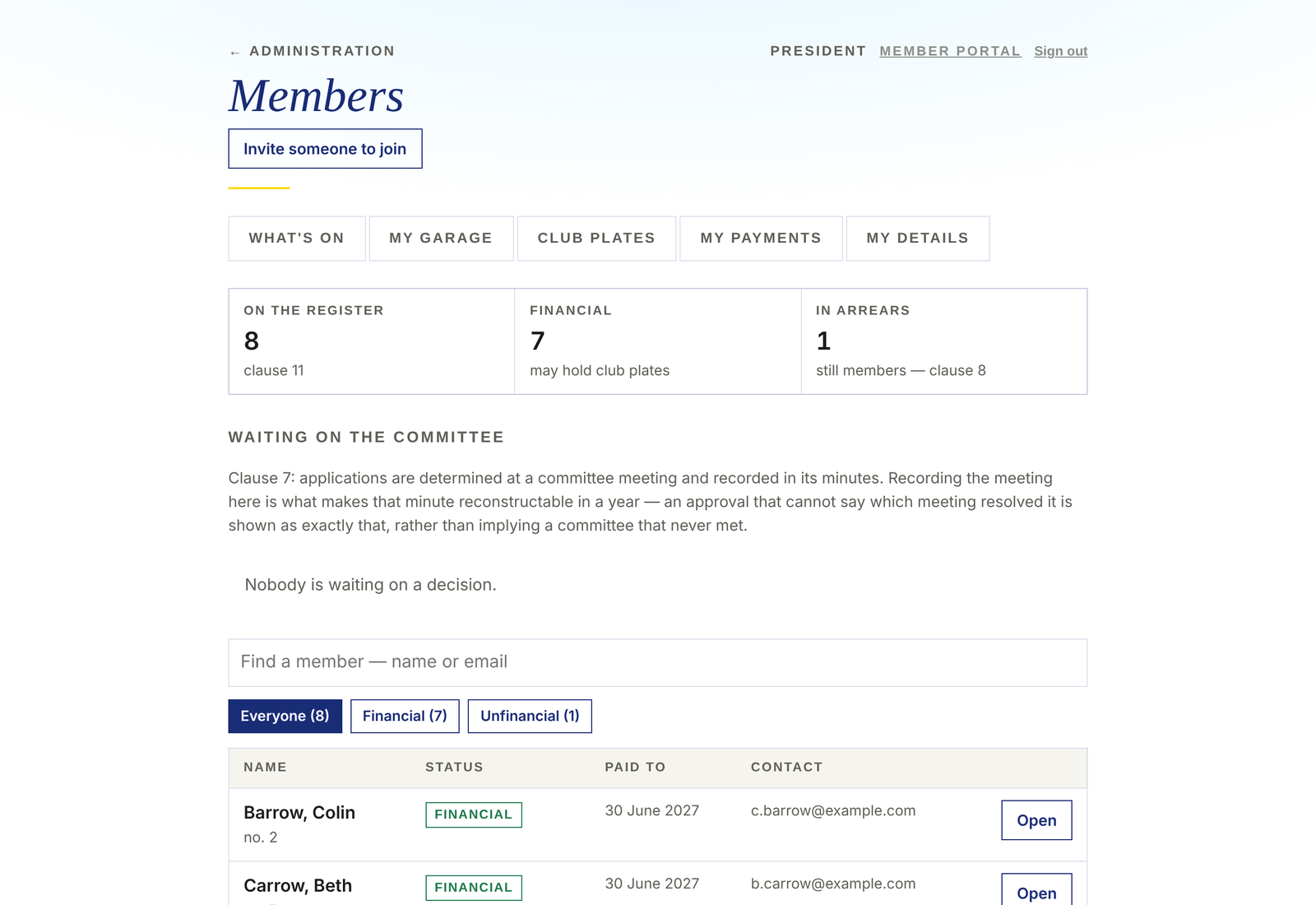
The statutory register — searchable, filterable, with history, and exportable to CSV and PDF. Members keep their own details correct instead of emailing the secretary. Offices and office holders carry effective dates, which feeds the list of club officials a scheme application asks for and decides who may do what.
Six requirements stand between a request and a stamp, each named in full where a committee can see it, and the software refuses rather than warns. Every act is audited — who, when, from where, with before and after — and nothing is deleted: a withdrawn declaration stays on the record showing that it was withdrawn. Only a Responsible Person signs.
Drives, shows and meetups, with RSVPs, guests and attendance. A member can suggest one from the members’ area: it arrives as a proposal owned by them, private to the committee, counted on the dashboard and emailed to everyone entitled to decide it. The committee amends it, approves it — which publishes it — or declines it with a reason the member is told. A declined proposal is kept and does not use up their allowance.
The scheme wants each event in the club’s minutes before it takes place — by a meeting, not a circulating resolution — and one meeting can adopt a whole quarter’s calendar. The day book is the other half: a dated entry, written once, never after the event has started. Approving an event offers to record it in the same press, because that is the step most easily forgotten and the breach cannot be repaired.
A read-only record of everything the club has tried to send, kept in the club’s own books rather than a mail provider’s dashboard, separating whether a message was accepted from whether it was delivered. It exists because this software once counted five subscription reminders as sent in a process that had no API key, and marked the members as reminded. “Did Alan ever get his invitation” is a question a club gets asked.
Fee schedules are set from a date, so changing this year’s subscription does not re-price last year’s invoices. Pro-rata first years, a joining fee charged once, and a subscription ledger behind every figure. Waiving a subscription is recorded as a payment with a reason, not an override — so a waived member is genuinely paid up.
A public page on the club’s own domain — its name, mark, colours and every word set by the club, not by a developer. Members sign in at the same address. The registration number and the subscription are drawn from the club’s record, so the page cannot drift from what the club actually charges.
A nightly sweep for arrears, reminders and renewals, with a record of each run so a sweep that silently stops is noticed. Backups of the whole register — every table, every stored file, and a plain CSV a person can read — verified against checksums. Two-factor sign-in for office holders.
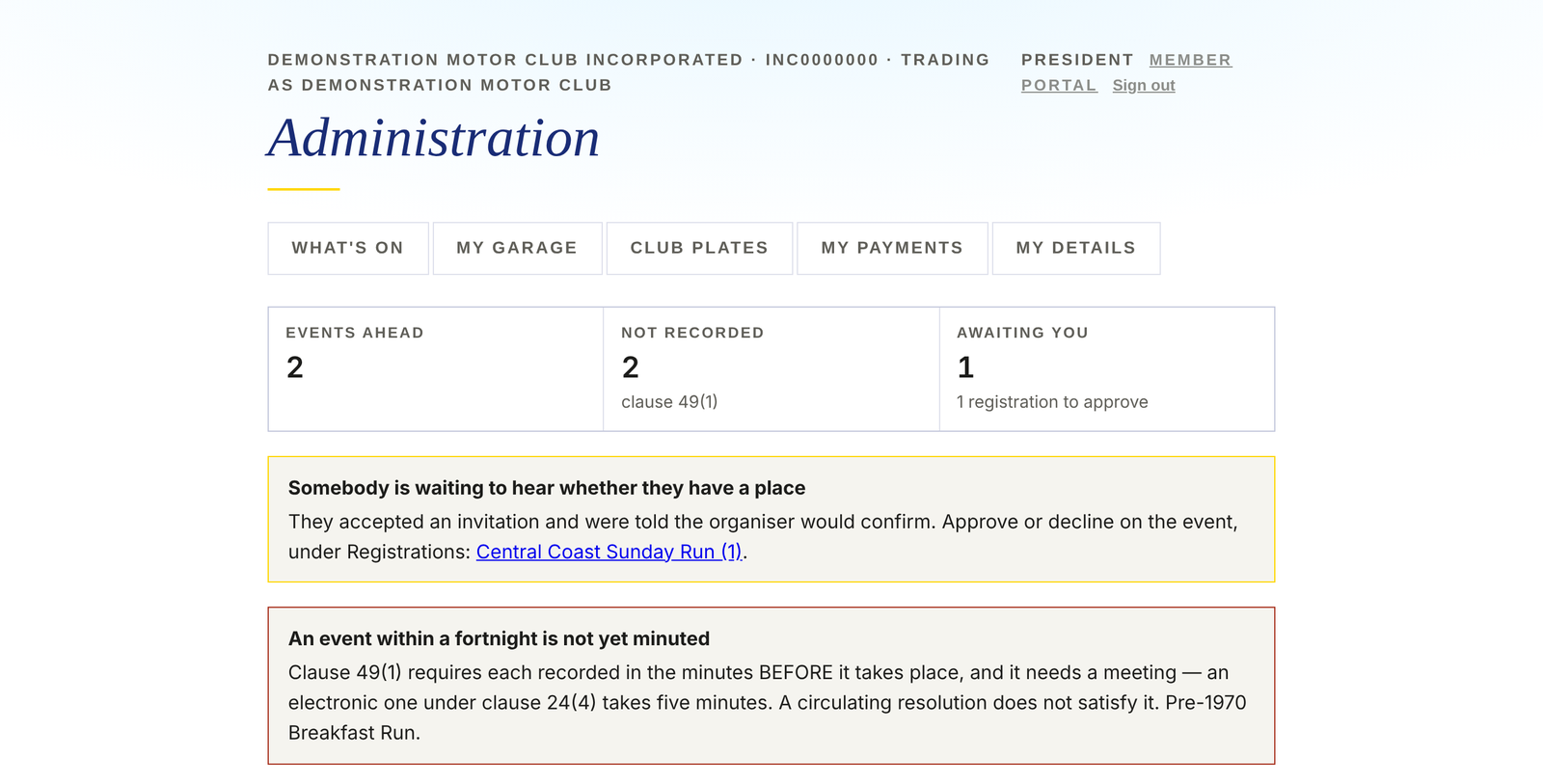
Real screens, with demonstration data. The club and the people shown are invented; no club's register appears here.
Two chains run through a club that signs declarations, and most software knows about neither. One decides whether a declaration may exist at all. The other decides whether an event the club held can support one. Every step of both is audited — who, when, from where, with before and after — and nothing is ever deleted.
Scroll the diagram sideways →
Six requirements, drawn from the scheme and the club’s own rules. A declaration that fails one is not produced — it is not produced with a warning on it either.
A run is not a calendar entry. It is the thing a member’s declaration may later rest on, so the order it happens in is the whole point.
A club may widen its own rule: Transport’s policy accepts the day book alone, and a club that passes the special resolution records the date it took effect. A date, not a switch — so an event held under the stricter rule is still judged by the stricter rule, rather than retrospectively excused.
CarClubSoftware is in production at a NSW incorporated association recognised by Transport for NSW, with a real register, real members and real money. Not a prototype, and not a demonstration account.
Club #1 is the maintainer's own club, which is said plainly rather than dressed up as a case study — and it is why the obligations are modelled the way they are. The software was written by somebody doing the secretary's job, for the parts of it that were going wrong.
A careful secretary is going to find these out anyway, so they belong on the page rather than in a meeting three weeks in.
There is no self-service onboarding. A club is set up by hand, which also means the first conversation is with a person who knows the scheme.
Members pay by bank transfer and the treasurer records it against the ledger. Card payment is designed and not built.
The scheme rules are held as data rather than written into the code, so another state is a seeding job rather than a rewrite — but no other state has been seeded, and the constitutional citations are NSW-specific.
The declaration form is original-only: it must be signed by hand and stamped. The software prepares, proves and archives. A person still signs.
Transport for NSW recognises the club, not the software. This helps a club meet its obligations; it cannot make a club eligible, and nothing here should be read as scheme approval of the product.
A club putting its statutory register on software with one maintainer is carrying a risk, and should know that before it decides rather than after. Full exports and verified backups exist partly for this reason.
There is no sign-up form here on purpose. A club's register of members is not something to hand over through a checkout, and the terms that ought to govern holding it are being written properly rather than quickly. If your club runs the scheme, or is applying to, get in touch and we can look at whether this fits.
Enquire about CarClubSoftware